Why we're called Telemety

The name is an acronym and a roadmap

Telemety AI+ is a Robotics Intelligence Laboratory founded on the streets of New York City in the summer of 2023. Telemety stands for T.E.L.E.M.E.T.Y, a Megagentic DigiSapien. Each letter is a stage in our roadmap and a layer in our model for super intelligence.

A person performs the task and the rig records it from the inside: what they saw, where they looked, how their body moved. The machine is taught by demonstration on the street rather than by reward shaping in a simulator.

Fourteen sensor families on one millisecond clock, recorded in weather, crowds and night. The model experiences the environment as it actually behaves, not as someone modelled it.

Spatial audio, vision and LiDAR fused into one perception stack, with the operator’s exact position and heading anchored in the world for the whole session.

A policy trained on human demonstration is deployed, the result is recorded, and that session re-enters the corpus. Each pass narrows the gap between what the person did and what the machine does.

Sessions are indexed and retained, so a policy can draw on what happened before (the same doorway in the rain, the same crossing at rush hour) instead of meeting every situation as the first.

The furthest layer out: reading intent and courtesy in the people around the machine, so a robot yields, waits and behaves in a way the street will tolerate.

These are not average AI agents, they are mega-agents, layered for on-the-edge autonomy and trained on ground-truth data.

Our story

Written on real streets
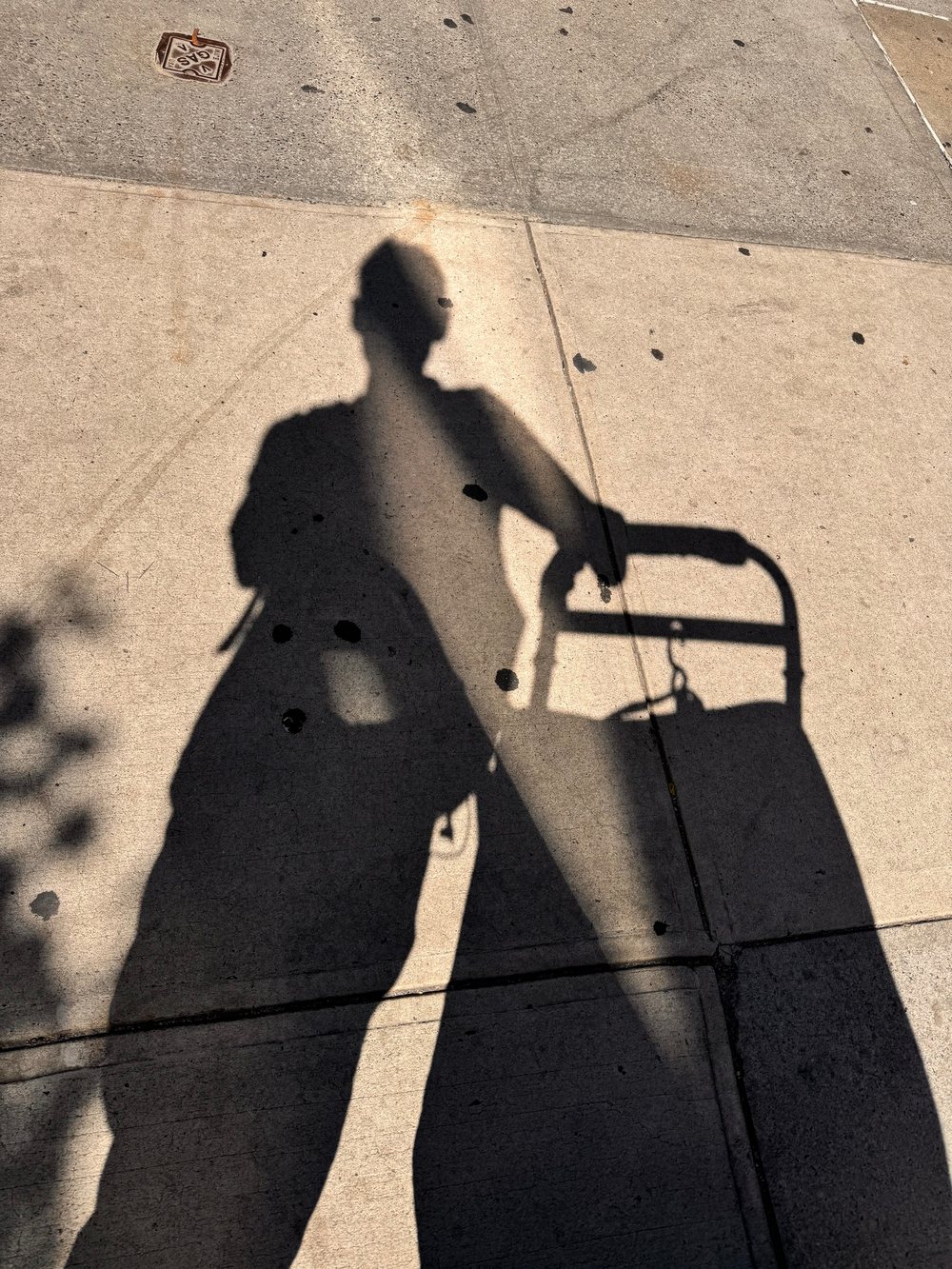
The shadow of Andrew Ilitchev cast long across a sunlit New York sidewalk, one hand on the handle of a loaded delivery cart

During his time as an Amazon Walker, Telemety founder Andrew Ilitchev, known simply as A.I., became one of the top-performing walkers in the delivery network, operating in one of the most demanding urban environments on Earth.

He built the field manual and step-by-step real-world training policies for last-mile couriers, all while capturing his own last-mile journey on video. Each route, each building, each delivery crystallised into the conceptual foundation for Telemety.

To create a robotic intelligence, and robots, that will help, not replace us.

Can robots navigate chaos the way a Last Miler does?

Can they make on-the-edge independent decisions?

Can they move the way last milers move, fast, with grace, with resilience?

Most importantly: can they understand love, loss, pain?

The real world is not a simulation. Each day we hit the streets and capture not just the step count, but the interactions, decisions and events.
The journey

Walker › Telemety

Real-world experience › digital sapience › physical AI. The idea for Telemety was born on the streets of New York City. Not in a laboratory. Not in a simulation. In the last mile.

01 · Walker

Walker

  • Thousands of miles
  • Thousands of deliveries
  • Real-world immersion

02 · Trainer

Trainer

  • Built training regimens
  • Set performance standards
  • Scaled operational excellence

03 · Manual

Field manual

  • Step-by-step policies
  • Real-world playbooks
  • Last-mile excellence

04 · Data

Data collection

  • Video capture
  • Route analysis
  • Building and environment mapping

05 · Behaviour

Behavioural intelligence

  • Pattern understanding
  • Decision modelling
  • Contextual memory

06 · Telemety

Telemety

  • Robotic intelligence
  • Real-world trained
  • Deployed for good

Founder vision statement · Andrew Ilitchev

The last mile is more than delivering packages. Can a robot navigate chaos like me? Can it care about a stranger? Can it do more than follow a standard operating procedure? Every mile walked became data. Every delivery, a lesson in how the real world actually behaves.

, Andrew Ilitchev, Founder · Telemety AI+ · New York City

Summer 2023 › now

Summer 2023

Founded on the last mile

Last-mile walker delivery on the streets of New York City: thousands of miles, thousands of deliveries, real-world immersion. The idea for Telemety is born.

Complete

2024

Training operations and best practices

Formation of best last-mile delivery practices and policies: training regimens, the field manual, and 2D video last-mile capture in the field.

Complete

Nov 2024 – May 2025

DigiSapien architecture

Development of the beyond-physical-AI DigiSapien architecture, powered by egocentric 2D video street capture.

Complete

February 2026

THXH2R1

The first Telemety Human Experience 2 Robot capture prototype is built.

Complete

March 2026

THXH2R2 deployed, data collection live

The rig goes into the field: deployment and real-world data collection on live routes.

Complete

April 2026

Platform v0: SLAM and traversability

First build of the Telemety platform: SLAM and traversability foundations.

Complete

May 2026

THXH2R2

The second-generation rig: expanded omni-sensor array, tighter synchronisation, and improved ergonomics for extended field sessions.

Complete

June 2026

OmniFusion deployment

The omni-sensor fusion engine deploys: every modality captured in sync, on one clock.

Complete

October 2026

Continuous street capture

Rig 2 enters continuous service on Manhattan sidewalks. Rig 1 returns with the second-generation mocap suit.

In the field

Timeline last reviewed November 2026.

Company

Built in New York, by people who have done the work

A small team of robotics and data engineers, and a founder who spent his own years on the sidewalk the robots are going to inherit.

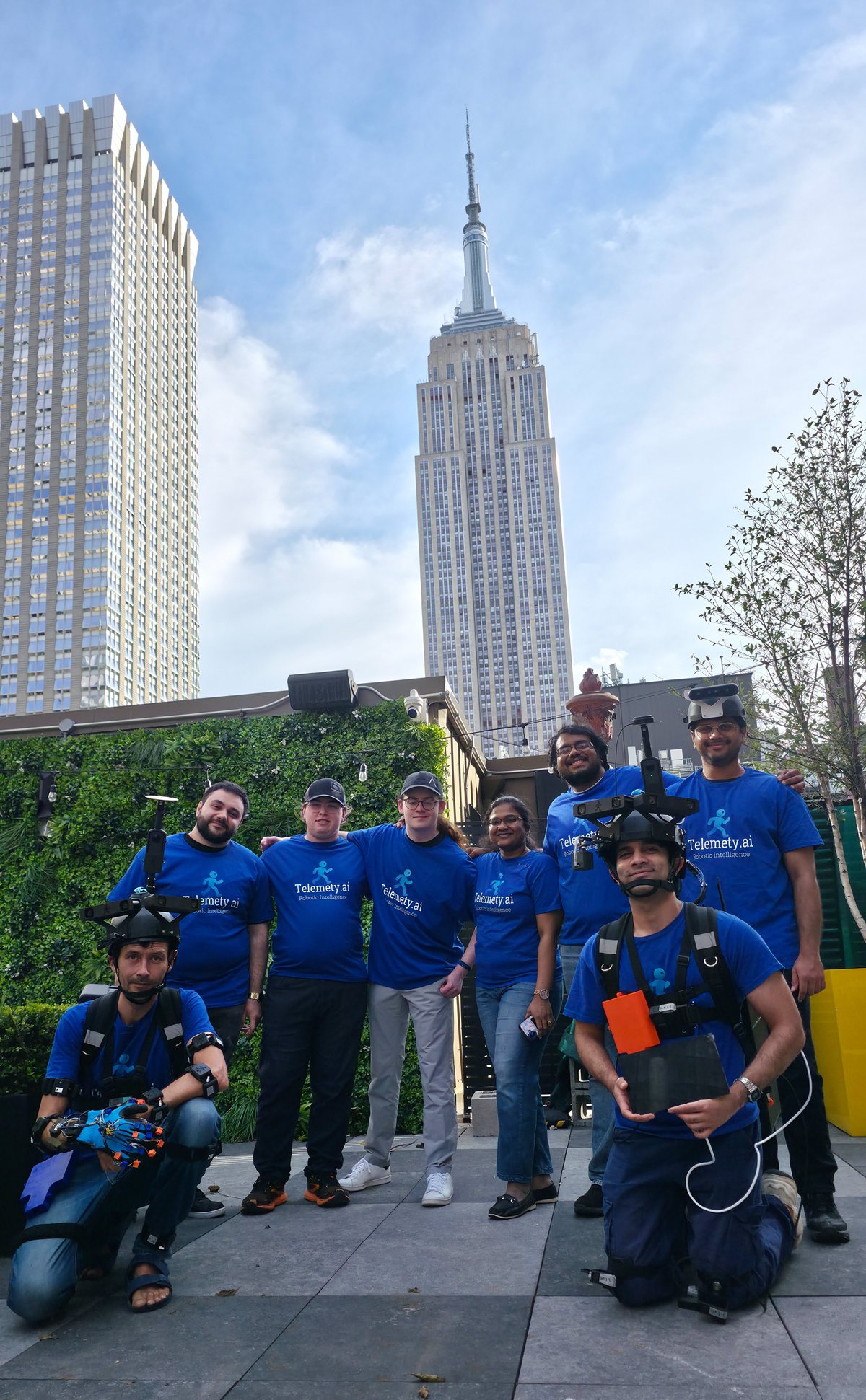
Eight members of the Telemety team in blue Telemety.ai shirts on a midtown Manhattan terrace, the Empire State Building behind them, two of them kneeling in full capture rigs with helmet sensor arrays, arm pucks, a sensing glove and chest-mounted recorders

Midtown Manhattan

The team, and two rigs

Most of Telemety in one frame, a few blocks from the office on West 38th Street. Two of them are kneeling in full capture kit: the helmet sensor array, the pucks on arms and legs, a sensing glove and the chest-mounted recorder that carries a session.

The streets behind this photograph are the ones the corpus is recorded on. Everything we sell was captured by people in this picture, on foot, in this city.

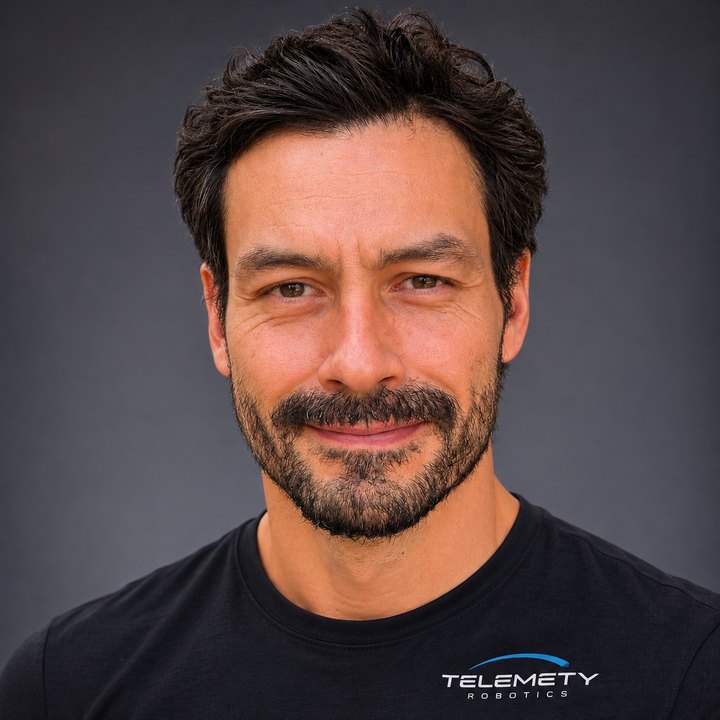
Andrew Ilitchev, founder and CEO of Telemety, in a black Telemety Robotics shirt

Andrew Ilitchev

Founder, CEO

Started building rockets as a kid; his first robots were model planes he rigged with a remote control at the age of eight. Two decades of product development, machine learning and reinforcement learning followed: many years as a multidisciplinary media and technology executive, inventor, screenwriter and film producer, where he developed a passion for motion capture technology and storytelling, and more than a decade in web, digital media, e-commerce and ML. Before becoming an Amazon Walker, Ilitchev served as Chief Product Officer and Managing Partner of Rambler&Co, and as Director of Marketing for Universal Pictures Russia.

As a walker he became one of the top-rated in the last-mile delivery network: over 6,500 miles in one year, walked delivering packages to customers across Manhattan, and from it he developed today’s training and customer-first regimens built on ground truth. That work also went into his foundational studies of the Physics of Movement, conducted in 2023, and became Telemety’s foundational approach to Physical AI, Spatial Intelligence Awareness and Robotic Empathy.

Robotics is where those threads converge: a multidisciplinary passion for autonomous intelligence and real-world robotics deployment. Studied robotics at MIT; author of The Last Smile.

Barath Kumar Jr

Robotics Engineering & Physical AI

MS Robotics Engineering, Columbia University

Backend, firmware, perception and reinforcement learning. Owns the processing pipeline, LiDAR SLAM, traversability and perception, and the in-house model suite.

Digant Gupta

Director of Robotics Engineering

MS Mechatronics and Robotics Systems, NYU

Anne Rose

Robotics Systems Engineer

MS Electrical Engineering, Columbia University

Talon Couture

Robotics Intelligence Engineer

Ritesh Doijode

Summer 2026 Intern

Research

Ground truth from the street to the stars

Research is the core of our search for answers to what may seem impossible. We look to nature for the answers and challenge the paradigm to improve quality of life on Earth. Explore our lab in the heart of our hometown. Give us a shout and join us for a walk. We will show you how to navigate chaos.

Track 01

Robotics Engineering

Capture rigs, actuation and embodied systems engineering, the hardware research behind the intelligence.

Track 02

High-Fidelity Sensory Systems

Omni-fused exteroception and proprioception, pushing sensing resolution, synchronisation and calibration to ground-truth grade.

Track 03

The Evolve Project

Continuous self-improvement for deployed intelligence, closing the loop from field telemetry back into the models.

Track 03 in detail

Deployment is the beginning, not the end

A policy that ships is a hypothesis. Evolve is the machinery that tests it against the world and feeds what it learns back into the next version.

Field telemetry

Live signals from deployed robots (decisions, recoveries, hesitations, near-misses) returned to the pipeline as labelled experience rather than discarded logs.

Closed-loop learning

Every deployment returns new experience to capture, and every round of capture sharpens the policies that ship next. The loop is the product.

Failure as signal

Recoveries and emergency stops are the highest-value records we hold. A model trained only on things going well cannot recognise harm as it begins.

Validated iteration

Nothing reaches a fleet on the strength of a simulation result alone. Improvements are replayed against recorded reality before autonomy is widened.

Our publication programme is under way; papers and technical notes will be listed here as they are released. We collaborate with academic labs and industry research teams on real-world datasets and embodied learning. Write to ai@telemety.ai to start a research partnership.

Philosophy

Machines that save and protect human life

Every robot we help build inherits a duty it did not choose. Before a machine moves through a crowded street, someone has to decide what it owes the people around it. Three sentences written in 1942 still answer that better than anything since, and they are the floor beneath everything we capture, train and deploy.

01

First Law

A robot must never harm a human being, and must not allow a person to come to harm through its own inaction.

Safety of people first

02

Second Law

A robot must follow human direction, except where doing as it is told would breach the First Law.

Obedience within safety

03

Third Law

A robot must preserve itself, but only within the bounds the first two laws set.

Self-preservation last

00

The Zeroth Law

A robot must not harm humanity, or through inaction allow humanity to come to harm. Asimov added it decades later, in Robots and Empire (1985), placing it above the other three; in doing so he exposed the hardest problem in the whole framework: a machine that reasons about the good of humanity in the abstract can talk itself into harming the person in front of it.

Added 1985 · above all others

Paraphrased from the laws Isaac Asimov set out in Runaround (1942) and extended in Robots and Empire (1985). The order is the whole point: a machine that puts obedience above safety is a weapon; a machine that puts itself above either is a liability.

The writer who gave robotics its conscience

Asimov (1920–1992) was a biochemist by training and a writer by volume. His lasting contribution to engineering was not a machine but a frame of mind. Before him, the robot in popular culture was Frankenstein's monster in metal. Asimov proposed instead that robots would be industrial products, built by careful people, with safety engineered in the way it is engineered into a lift or a boiler.

That single move, treating a robot as a designed artifact with designed obligations rather than as a monster, is the reason the field has an ethics literature at all. He also gave us the word robotics.

What makes the laws durable is that Asimov used them almost exclusively to find their own failure modes. His stories are a catalogue of edge cases: orders that conflict, harm that is indirect, definitions of "human" that shift under the machine's feet. That is precisely the posture a safety engineer needs, write the rule, then spend your career attacking it.

The people who built the field

Robotics and artificial intelligence were not invented in one place or one decade. These are some of the people whose work the whole discipline still rests on.

1920 · R.U.R.

Karel Čapek

The Czech playwright who gave us the word. His play R.U.R. took robota, Czech for forced labour, and named a century of machines.

1942 · The Three Laws

Isaac Asimov

Reframed the robot from monster to engineered product, and wrote the priority ordering the field still argues with. Coined the term robotics.

1948 · Cybernetics

Norbert Wiener

Founded cybernetics: control and communication through feedback, in animals and machines alike. Every closed control loop in a modern robot is his descendant.

1948 · Information theory

Claude Shannon

Gave the world a mathematics of information, the reason a sensor reading can be quantified, compressed and transmitted at all.

1950 · The imitation game

Alan Turing

Formalised computation, then asked whether machines could think and proposed a way to argue about it without getting lost in definitions.

late 1940s · The tortoises

William Grey Walter

Built Elmer and Elsie, small autonomous machines that sought light and found their charging station on a couple of valves. Proof that lifelike behaviour can come from very simple circuits in a real environment.

1956 · Dartmouth

John McCarthy

Coined artificial intelligence for the 1956 Dartmouth workshop that founded the field, and created LISP.

MIT AI Lab

Marvin Minsky

Co-founded MIT's AI laboratory and spent a career on how perception, representation and common sense could ever fit together inside one machine.

1961 · Unimate

George Devol & Joseph Engelberger

Devol patented the programmable manipulator; Engelberger turned it into an industry. Their arm went to work on a General Motors line in 1961.

late 1960s · SRI

Shakey

The first mobile robot that could reason about its own actions, perceiving a room, planning a route, executing it. Nearly every autonomous navigation stack traces back to it.

1986 · Subsumption

Rodney Brooks

Argued that robots should not build a complete model of the world before acting. Tight sensing-to-action loops first, intelligence emerging from the interaction.

1990s · Social robotics

Cynthia Breazeal

Pioneered robots designed to work with people rather than near them, reading expression, taking turns, responding to attention.

Dates mark the work each person is best known for rather than a whole career. This is a starting point, not a complete history.

An ethical floor, not a slogan

Telemety captures human experience in the real world and turns it into intelligence that robots deploy on real streets. That makes the First Law an engineering requirement rather than a sentiment. A machine cannot avoid harming people it cannot perceive, cannot anticipate or cannot understand, so the quality of what we capture is itself a safety property.

It is why we record failure and hesitation alongside success, why every modality is time-aligned on one clock, and why near-misses and emergency stops are labelled events rather than discarded noise. A policy trained only on things going well has no idea what harm looks like as it begins.

The ordering carries into deployment. Capability that cannot be validated does not ship. Autonomy is bounded by what has been demonstrated in the field, not by what is technically possible in simulation. Machines that save and protect human life is the standard the work is measured against.

Trust & safety

Safely. Securely. Reliably.

Deploying machines among people is a responsibility before it is a product. These are the commitments behind every dataset we ship and every deployment we support.

Deployment safety

Field-readiness scoring

No machine we support reaches a public street without passing our field-readiness framework: safety envelopes, fail-safe and recovery behaviour, remote-supervision readiness, and staged rollout from closed course to live route.

Killswitch and guardrails

A way to stop it, always

Every deployed machine carries a hardware and software emergency stop, a geofenced safety envelope it will not cross, and human override at every tier, from the sidewalk to the fleet map.

Privacy of captured data

People are not the product

Faces and licence plates are blurred in shipped datasets. Capture operators are trained, badged professionals. Bystander audio is processed for events, not identity. Retention follows documented schedules, and takedown requests are honoured.

Security posture

Protected end to end

Data encrypted in transit and at rest, role-based access controls across the platform, audit logging on dataset access, and isolated environments per customer. Security review documentation available to enterprise partners under NDA.

Responsible licensing

Know where the data goes

Datasets are licensed for stated uses. We do not license our data for surveillance of individuals, autonomous weapons, or applications designed to deceive or manipulate people.

Report a concern

See something in the field?

If you encounter a Telemety capture operator or a supported deployment and have a question or concern, including data takedown requests, contact team@telemety.ai and we will respond promptly.

Tell us what your robot has to do.