Robotics Solutions
Multimodal ground truth data corpus for Robotics RL and Real World Deployment
Recorded on real streets, time-synced to the millisecond, published in ROS 2. Alongside the corpus we offer the parts of our own stack that stand on their own: the perception engine that colours the world in 3D, the motion capture suit that works outside a studio, and the deployment layer that keeps a machine safe once it is out there.
01 · Data
Ground truth, not a reconstruction of it
A reinforcement-learning or VLA policy is only as good as the experience behind it. Ours is recorded from inside the task: what the operator saw, where they looked, how their body moved and what the ground did under their feet, all on one millisecond clock, so the cause and the action line up to the frame.
- Fourteen sensor families, one clock. 360° and egocentric video, stereo depth, LiDAR, IMU, GNSS, spatial audio, gaze and full-body kinematics, time-aligned to the millisecond.
- Indexed three ways. By sector; by capability (locomotion, dexterity, perception, navigation, intent, interaction, force); and by the reconstruction layer underneath.
- Anonymised before it leaves our pipeline. Faces blurred at source, speech removed, consent on the record where people take part.
- Delivered in your format. ROS 2 topics and bags, rosbag2 and MCAP, ready for your own or a third-party partner platform.
02 · Perception · built in-house
See the street the way your robot will
Telemety Coloured SLAM fuses camera frames onto a live LiDAR point cloud, so every point carries the colour of the surface it hit. You get geometry and appearance in one pass: a 3D map that looks like the block it was recorded on, with the camera's exact path through it.
- Colour and geometry together. One pass, one clock, no post-hoc registration between a mesh and a photo set.
- No base station. LiDAR, camera and GNSS are fused in real time, so there is no RTK mast to place, no site survey and no permit to obtain.
- Built for outdoors. Developed on Manhattan sidewalks in traffic, weather and crowds, not in a corridor.
- Ours end to end. Written in-house, so it can be tuned to your sensor set rather than wrapped around someone else's.
Try Coloured SLAM on your own route
Send us a route, a site or a short clip from your own sensors and we will run it and send back the reconstruction. Requests go to ai@telemety.ai.
Your request, send it to ai@telemety.ai
Nothing has been sent yet. Send the email, or paste this to ai@telemety.ai.
Coloured SLAM is deployed and running in capture sessions today, on top of the LiDAR SLAM geometry layer beneath it.
03 · Motion capture systems
Motion capture with no volume to stay inside
The Telemety Mocap Suit was built because studio systems stop at the door. It is inertial, so there is no camera rig, no line of sight and no capture volume, and it stays accurate across a whole city for a whole working day.
- Seventeen wireless pucks, nothing else. No body hub, no cable harness, no battery belt. Put the pucks on and walk out of the door.
- One clock with the whole capture stack. Every puck is synchronised with the cameras, LiDAR, gaze and insoles, so a footstep is the same footstep in every stream.
- Holds its heading beside steel and traffic. No compass to disturb, so scaffolding, vehicles and subway grates do not bend the data.
- Unlimited range, indoors and out. Rain, snow, night and glare, block after block, with nothing to stay inside.
- Ours end to end. Hardware, firmware and software are designed and built in-house, so the suit evolves with what the corpus needs.
17
wireless pucks, no hub, no harness
One clock
synchronised with every other stream in the rig
All day
a full working shift on a single charge
Any weather
rain, snow, night and glare, indoors and out
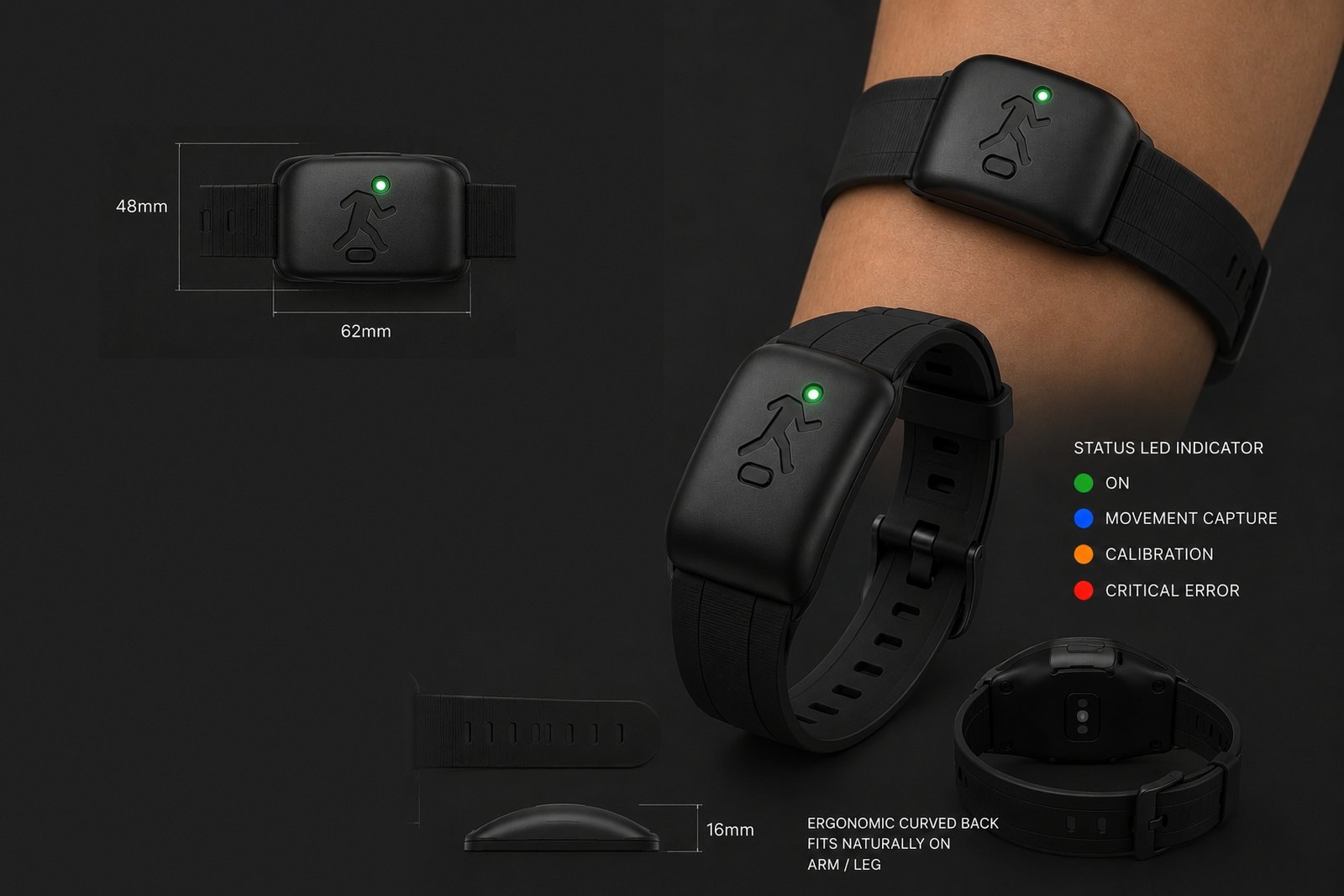
17 intelligent motion capture pucks
for all-weather conditions
Highlights
What the suit gives you
Full-body motion from real work, in the places work happens. Everything below is included with a leased capture engagement; the detailed specification sheet is shared with customers on request.
Full-body kinematics
seventeen pucks over head, torso, arms, hands, legs and feet
Hand tracking
in-house Smart gloves for per-finger pose and pressure
Street accuracy
holds its accuracy block after block, for a whole working day
Magnetic immunity
no compass, so steel, traffic and rail do not disturb it
Remote control
power and calibration from the Telemety dashboard on any device
Status at a glance
an LED on every puck: on, capturing, calibrating, fault
Labelled as it happens
every stair, leap, lift and carry logged in the Telemety taxonomy
Delivered as ROS 2
rosbag2 and MCAP, time-aligned with the rest of the capture stack
Telemety Retargeting Engine
From a person’s motion to your robot’s joints
Motion is captured on a person, and your robot is not one. The retargeting engine maps a recorded human episode onto the kinematics of the machine you are actually deploying — its link lengths, joint limits, degrees of freedom and balance constraints — and returns a trajectory that platform can execute, rather than a human pose it can only approximate. Pick your machine from the robot library, or bring your own URDF.
01 / SELECT
Choose the robot
Pick a platform from the library, or upload a URDF and we build the profile from it.
02 / SOLVE
Constrained retarget
Inverse kinematics against joint limits, velocity limits, self-collision and the support polygon.
03 / CHECK
Feasibility pass
Contact timing and centre-of-mass feasibility flagged frame by frame, so you see what will not transfer.
04 / EXPORT
Joint trajectories
Out as ROS 2 topics, rosbag2 or MCAP, replayable against the episode in the H2R Platform.
Robot library
Profiles are organised by morphology, because that is what decides whether a human motion transfers at all. Each profile carries the platform’s kinematic tree, joint limits and contact model.
Humanoids
full-body bipeds · 20–40 DoF · whole-body balance
Wheeled humanoids
torso and arms on a wheeled base · no gait transfer
Quadrupeds
four-legged bases, with and without an arm
Manipulators
single and dual-arm · 6 and 7 DoF
Hands and grippers
five-finger, three-finger and parallel-jaw · fed by the Smart gloves
Rovers and AMRs
wheeled and tracked bases · navigation and manipulation split
Drones
path and gaze transfer only · no limb retarget
Your own build
upload a URDF · we confirm the profile before you commit
Retargeting runs on the same episodes the corpus is delivered in, so a trajectory can always be traced back to the person and the session it came from. Tell us the platform you are deploying and we will confirm its profile, and what will and will not transfer to it, before you sign anything. Platform names are the trademarks of their owners; a profile is built from a published or supplied kinematic description, not from a partnership.
Request the Telemety Mocap Suit
Tell us the motion you need captured and where. The suit is deployed on leased capture engagements with our operators. Requests go to ai@telemety.ai.
Your request, send it to ai@telemety.ai
Nothing has been sent yet. Send the email, or paste this to ai@telemety.ai.
04 · Robot Training · coming 2027
Teach your robot the street, not the simulator
Robot Training is where an owner builds their own machine's skills on real-world experience. You pick the behaviour you need, draw on recorded human episodes of people doing exactly that, and train, evaluate and refine a policy for your platform — without standing up a capture programme or a simulation team of your own.
- Trained on the real world. Every skill is grounded in recorded human episodes from live streets, with the gaze, force and body kinematics that produced the action, not a reward function approximating it.
- Your robot, your skills. Build a skill library specific to your machine and your task, owned by you, extended session by session rather than bought as a fixed dataset.
- Evaluate before you deploy. Replay a candidate policy against recorded reality and see where it diverges from what the person did, before it reaches a sidewalk.
- Commission what is missing. If the behaviour you need is not in the corpus, we record it — your routes, your task, through the same pipeline.
Proof of concept · simulation study
Human ground truth makes a humanoid walk better
Before the product, the evidence. We took the centre-of-pressure path a person actually walks, measured with Telemety pressure insoles, retargeted it onto a humanoid’s gait in simulation, and ran it against engineered baselines over paired courses. Four findings on what human ground truth adds that a hand-written gait does not.
+16.4%
wider foot-support margin at the foot edge than an engineered linear CoP path — 12 paired courses, Holm p = 0.008
60%
the human path compressed to 60% of its excursion and still inside the non-inferiority margin on falls — 128 paired fast courses
64
taxels per sole, resolving foot contact an ankle force/torque sensor never sees
42–52%
lower support-fraction error than a 6-axis F/T sensor on unknown rough terrain
Robot Training is in development for 2027 and is not available today. Early-access places go first to pilot and licence customers, whose captures seed the skill library it is built on.
05 · Deployment solutions
What keeps a machine safe once it is out there
Capture is half the job. The other half is everything a machine needs on the day it leaves the lab: behaviour people can read, a live sense of its own certainty, a memory the fleet shares, and a way to stop it that always works.
Intelligence
Human-First Robotic Intelligence
Behaviour designed on real human experience, machines that move and decide the way streets expect.
- Human-grounded behaviour, movement and decisions trained on real human experience, not synthetic assumptions.
- Social right-of-way, yielding, merging and spacing the way people expect.
- Predictable motion, machines that read as legible and trustworthy to the people around them.
RCS
Robotic Confidence Score
Live, per-decision confidence of the deployed machine, streamed in real time.
- Perception certainty, frame-by-frame confidence in what the machine sees and classifies.
- Plan stability, how stable the chosen plan is across the prediction horizon.
- Intervention likelihood, a live estimate of when a human or fallback should step in.
Memory
Episodic Memory Factor Graph
Every deployment episode becomes a node in a factor graph the fleet can query.
- Episodic nodes, each run, place and event stored as a queryable node.
- Fleet-wide recall, one machine's correction becomes every machine's memory.
- Outcome tracking, places, events and corrections linked to their outcomes over time.
Killswitch & guardrails
A way to stop it, always
Designed and developed from years of customer-centric best practices harnessed from the field. Every deployed machine carries a way to stop it, a boundary it will not cross, and a person who can always take over, before any of it is a policy question.
Hardware and software stop
A physical emergency stop on the machine, a remote stop in the operator console, and a software stop any tier of the platform can trigger. All three land on the same safe state: motion halted, actuators de-energised, state logged. None of them depends on the network being up.
Safety envelope, enforced
The operational bounds the machine will not cross (speed, proximity to people, restricted zones, hours of operation) are enforced on the edge, not advisory. The same envelope URDS certifies against.
Human override at every tier
From the sidewalk, from the operator console, from the fleet map. Intervention thresholds are part of the deployment record, and every override is captured as an episode the fleet learns from.
Graceful degradation
Sensor dropout, sync drift, a lost fix or a low confidence score does not produce a guess. It produces a slower, more conservative machine, then a stop. The Robotic Confidence Score is what decides.
Incident capture and disclosure
Every stop, near-miss and override is recorded on one clock with the full sensor context, reviewed, and reported to the customer. What happened and why, not a summary.
From the field, not the lab
These guardrails come from thousands of miles of last-mile work in New York City: the practices that kept couriers, customers and bystanders safe, written into the machine.
The deployment layer is specified and offered as part of a deployment engagement rather than sold as shipping software. Tell us your platform and timeline and we will set out what is implemented today and what would be built for you.
06 · Compute · Telemety Training GPU Cluster
A peer-to-peer network that turns raw capture into delivered data
An hour on the street arrives as terabytes that have to be decoded, time-aligned, annotated, packaged and shipped — and then served again every time a policy runs. Telemety spreads that work across a peer-to-peer network of GPUs instead of renting one monolithic cluster: encrypted shards go out, verified results come back, and the people who own the idle silicon are paid for the cycles.
- Processing. Decode, rectify, align every stream to the one-millisecond clock and build the SLAM and trajectory products from the raw session.
- Automated annotation. Objects, paths, contacts, gaze targets and action labels proposed by model, checked against the recorded ground truth, with a human in the loop on anything low-confidence.
- Packaging. Cut, filter and write the episodes to ROS 2 bags, rosbag2 and MCAP, with checksums and a provenance record per shard.
- Delivery. Signed bundles pushed to the customer, resumable, with the same manifest the Intelligence Library indexes against.
- Inference. Spare capacity on the network serves policy evaluation and replay for the H2R Platform, close to where the data already sits.
Work is split into shards that carry no raw personal data: faces and plates are already blurred and speech is muted at source before anything leaves Telemety. Every shard is encrypted in transit and at rest on the node, every result is checked against a redundant copy before it is accepted, and a node never sees a whole session. Scroll the diagram sideways on a narrow screen.
If you are not using your GPU, put it to work
Most of the compute this industry needs is already bought and sitting idle in bedrooms, studios and small offices. Join Telemety, install the node client, and your card earns while you are asleep or away from the desk.
- Sign up. Tell us what card you own, where it lives and roughly when it is idle.
- Install. One sandboxed client for Windows or Linux. It takes work only when the machine is yours to lend, and yields the instant you come back to it.
- Monetize. You are paid per unit of verified work, metered on the node, settled monthly. No lock-in: pause or leave whenever you want.
What runs on your machine
A single client process, sandboxed, with no access to anything outside its own working directory. It does not mine, does not touch your files, and does not stay resident when you are using the machine. You set a ceiling on power draw and on hours. Shards are encrypted on disk and deleted when the unit of work is returned. Payouts are per verified unit, and a unit is only verified once a second node independently reproduces it.
Sign-ups are open now; nodes are being enrolled in batches as the scheduler is hardened. Tell us your card and we will tell you which tier of work it will take and when your batch opens.
| Blackwell · GeForce RTX 50 series | |
|---|---|
| RTX 5090 | 32 GB GDDR7 · training, annotation, packaging, inference |
| RTX 5080 | 16 GB GDDR7 · training, annotation, packaging, inference |
| RTX 5070 Ti | 16 GB GDDR7 · annotation, packaging, inference |
| RTX 5070 | 12 GB GDDR7 · annotation, packaging, inference |
| RTX 5060 Ti | 16 GB or 8 GB · processing, packaging, verification |
| RTX 5060 | 8 GB · processing, packaging, verification |
| RTX 5050 | 8 GB · processing, packaging, verification |
| Ada Lovelace · GeForce RTX 40 series | |
| RTX 4090 | 24 GB · training, annotation, packaging, inference |
| RTX 4080 / 4080 Super | 16 GB · annotation, packaging, inference |
| RTX 4070 Ti Super | 16 GB · annotation, packaging, inference |
| RTX 4070 Ti / 4070 Super / 4070 | 12 GB · processing, packaging, verification |
| RTX 4060 Ti | 16 GB or 8 GB · processing, packaging, verification |
| RTX 4060 | 8 GB · processing, packaging, verification |
| Ampere · GeForce RTX 30 series | |
| RTX 3090 / 3090 Ti | 24 GB · annotation, packaging, inference |
| RTX 3080 Ti / 3080 12 GB | 12 GB · processing, packaging, verification |
| RTX 3080 | 10 GB · processing, packaging, verification |
| RTX 3070 Ti / 3070 | 8 GB · processing, packaging, verification |
| RTX 3060 | 12 GB · processing, packaging, verification |
| Workstation and data centre | |
| RTX 6000 Ada / A6000 | 48 GB · every tier of work, priority scheduling |
| L40S, A100, H100 and above | by arrangement · contact us before you enrol |
| Minimum to enrol | |
| GPU | 8 GB VRAM, Ampere (RTX 30) or newer · one card or many |
| Host | 16 GB system RAM, 60 GB free disk, 100 Mbit upstream |
| OS | Windows 11 or Linux · the client is sandboxed and yields to you |
| Not supported | GTX 10 / 16 series, RTX 20 series, and AMD or Intel GPUs for now |
The Training GPU Cluster is in build and enrolling nodes in batches; it is not yet carrying the full production pipeline. Tiers describe the kind of work a card is scheduled for, not a guarantee of throughput — actual allocation depends on VRAM, upstream bandwidth and how long the node stays online. Card names and memory configurations are NVIDIA's.
What you can buy
Four ways to work with us
Pilots are priced as an evaluation, not as margin. Licences are non-exclusive by default; field exclusivity is available as a licence term rather than an equity one. Tell us which route fits and we will send the numbers.
EVALUATE
Scoped pilot
Twenty-five reviewed hours matched to one task of yours, delivered as encrypted MCAP in two to three weeks.
- One task, one surface type
- Every deployed stream
- Annotated and sync-verified
- Delivered by hand or API
COLLECT
Custom collection
Our operators record your routes and your tasks. You own the resulting episodes outright.
- Your routes, your schedule
- Six capture hours per rig-day
- Same pipeline and formats
- Ten-day minimum
LICENSE
Dataset licence
One hundred and fifty reviewed hours of the urban navigation corpus by taxonomy slice, served through our API.
- Non-exclusive
- By task, surface or weather
- ROS 2 / MCAP; LeRobot on request
- Re-delivery as the corpus grows
SUBSCRIBE
Data Cloud
Continuous access to the corpus and to every new taxonomy slice as it is published.
- Rolling access
- New slices included
- Priority on custom capture
- Strategic tier available
Activity datasets for warehouse handling, construction and workshop operations are in planning, and URDS route and robot scoring is in development for 2027. Ask us about either. The full capture system is described on the capture system page.